
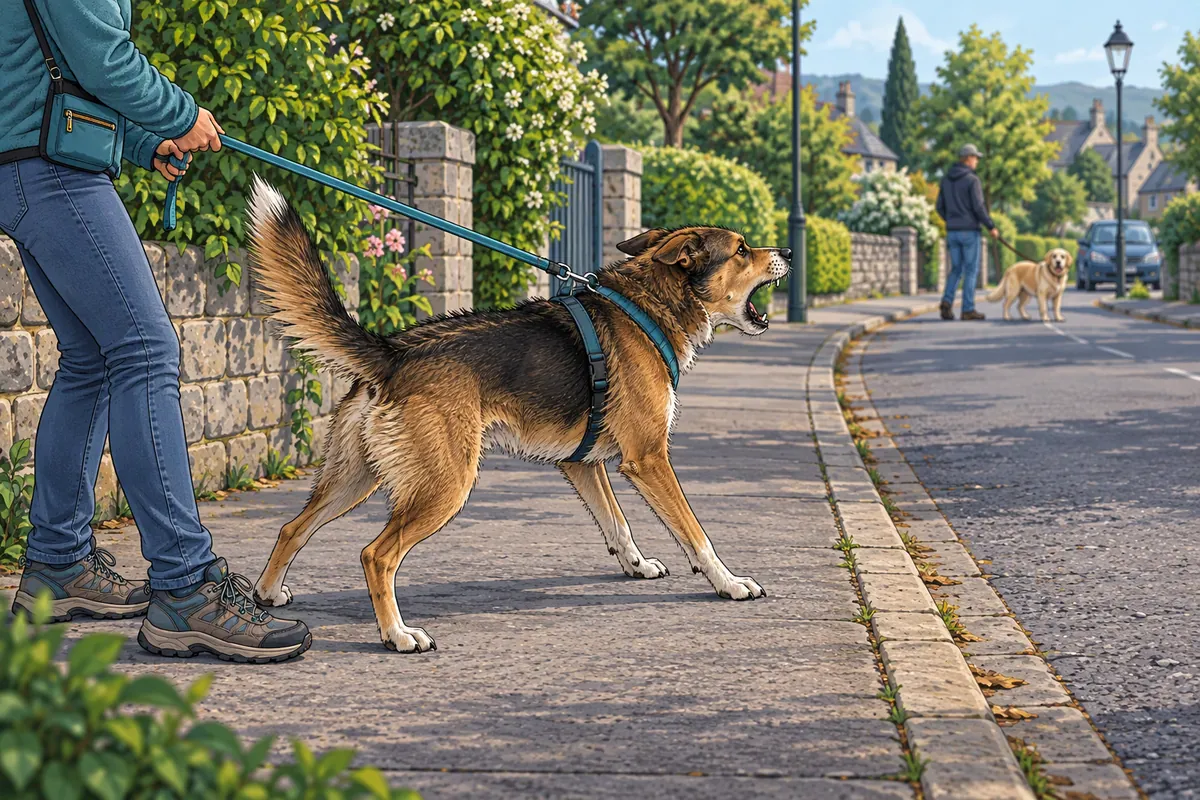
Another dog appears at the end of the lane and he’s up on his back legs, barking. Or it’s a jogger, a bike, a tractor, the postman at the gate. You’ve started walking at odd hours, crossing the road, dreading the corner. Maybe you feel judged by people who don’t know him.
Reactivity covers a familiar set of behaviours: going stiff, staring, growling, barking, lunging, snarling or snapping at something. It can happen almost anywhere:
- on walks, towards other dogs, people, children, bikes or traffic
- at home, at the window, the gate or the fence, or when someone comes to the door
- in the car, at things going past
- in tight spots, such as narrow paths, the vet’s waiting room, or being held on a short lead
You didn’t cause this by being a bad guardian, and he isn’t trying to be difficult. He’s showing you, as loudly as he can, how he feels about something.
The same bark, different reasons
Two dogs can bark and lunge in exactly the same way for completely different reasons. One is frightened and wants the other dog to go away; the other is desperate to say hello. I find Emma Lee’s way of looking at this especially helpful: rather than one label, she looks at the different things that can drive reactive behaviour, and most dogs have more than one (Lee, 2022a). Some of the most common, with clues that can help tell them apart:
| What might be driving it | Clues you might notice |
|---|---|
| Frustration (“I want to get to it!”) | Worse on lead than off; pulls towards the other dog or person; often calms down once allowed to greet; gets worse the longer he’s held back |
| Fear (“Go away!”) | Reacts to the trigger itself, not before it appears; may back off, freeze or hide behind you first; may refuse food; settles once the trigger has gone |
| Worry (“Something might happen”) | On edge before anything appears; scans the horizon; won’t sniff or toilet on walks; relieved to get home |
| Guarding home (“Not here!”) | Much louder at home than out; uses a lookout spot at the window or gate; eases as the person or dog moves away |
| Chase (“It’s moving!”) | Fixed stare, head low, creeping; triggered by bikes, runners, cars or wildlife; gets more intense as the thing moves away |
| Feeling trapped (“I can’t get away”) | Worse on a short lead, in narrow spaces, in the car, or when held |
Which way the trigger is moving is a useful clue: a frustrated or chasing dog often gets more worked up as it moves away, while a frightened or guarding dog usually relaxes.
This matters because the help is different. A frightened dog needs to feel safer; a frustrated dog needs to learn to cope with not getting what he wants. Some approaches that help one can make the other worse.
Start with your vet
Pain is an easily missed reason for a dog to snap or lunge. A sore back, hips, ears or teeth make any dog less tolerant and quicker to react (Camps, Amat and Manteca, 2019; Mills et al., 2020). This matters even more if the behaviour is new, has got worse, or happens when he’s touched or bumped. Some medicines can also affect behaviour, so mention anything he takes.
For some dogs, especially those who are frightened or worried much of the time, medication from your vet can lower their stress enough for training to work. There’s more in Medication for anxiety.
Fewer bad moments
Every time he barks and lunges, he gets more practised at it, and his stress takes time to come back down. So before any training, the most useful thing is usually to cut down how often it happens.
On walks
- Choose quieter routes and times, and places with room to move away: wide verges, open fields, paths with turn-offs.
- Give yourself space. Watch ahead, cross the road, step behind a parked car, or turn round early. Turning away isn’t failing; it’s good planning.
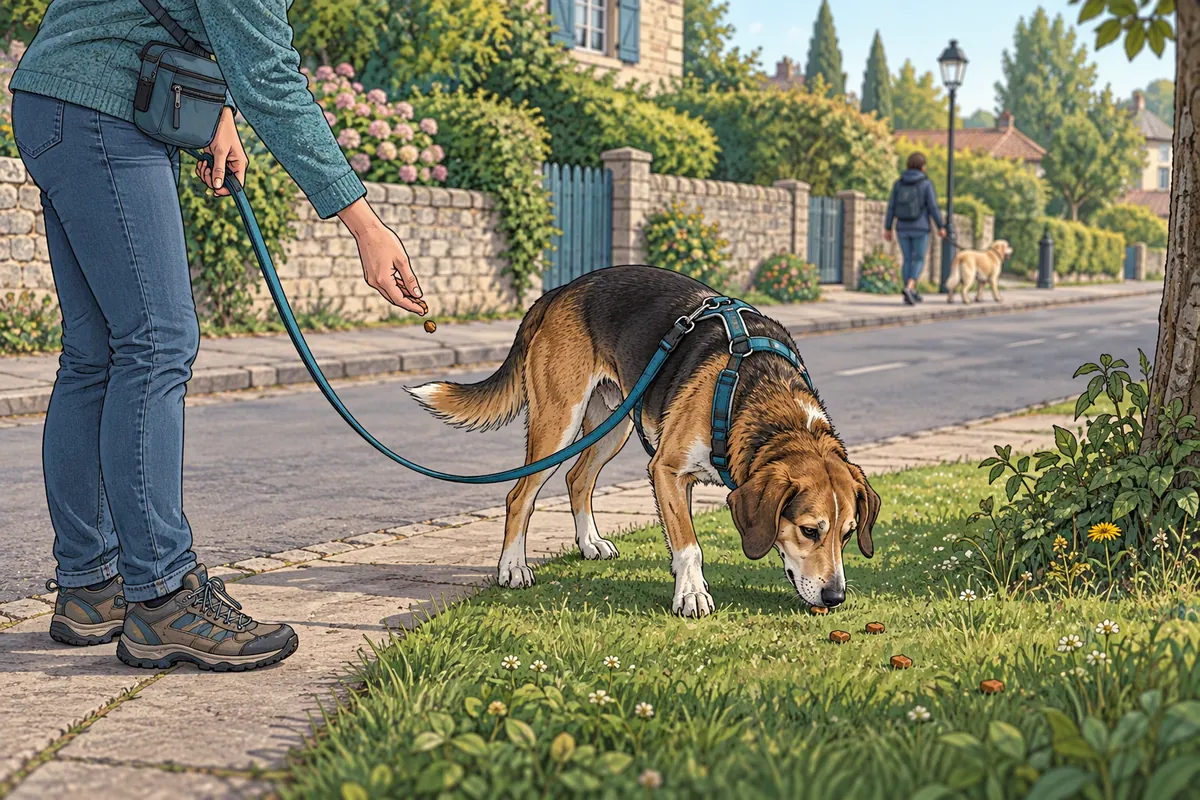
- Swap some walks for sniff walks on a long line somewhere quiet, or for games and food puzzles at home. Taking a break from difficult walks for a while is fine.
- Check your equipment. A well-fitted harness and a longer lead are usually more comfortable than pressure on the neck (Pauli et al., 2006; Carter, McNally and Roshier, 2020), and tension on the lead can add to the tension in him.
At home
- Block the lookout spots. Move the sofa from the window, use window film, or close off the gate view.
- Mask the noise with music or the radio at busy times of day.
- Give him something to do at the times things usually go past, like the school run or the post.
- Have a quiet retreat he can always go to, where no one disturbs him.
At the neighbour’s fence
Racing up and down a fence with another dog can look like a game, but it usually winds both dogs up rather than letting off steam, and it can spill over into the rest of the day.
- Keep him away from that stretch for now. Use a long line in the garden, a temporary inner barrier, or garden time when the other dog is inside.
- Block the view. Screening such as reed, willow or windbreak netting along the boundary takes away much of the trigger.
- Give the garden another job. Scatter food, sniff games or a digging pit at the far end make it a place for calmer things.
- Talk to your neighbour. Agreeing different garden times can help both dogs. Many neighbours are glad to have a plan too.
- Call him away early, with your U-turn cue, before he gets going, rather than once he’s at full volume.
Those steps stop the fence running from getting worse. To change it for the long term, use the skills below at the fence, starting well back from it. When the other dog is out, reward him for looking at the fence and then back to you, or for choosing to sniff or play somewhere else. Move a little closer only when he can stay loose and take food. Most dogs can learn to share a boundary calmly, though many families keep some screening in place for good.
Skills that help
These are worth teaching somewhere calm, before you need them. Practise at home and on quiet walks until they’re easy, then use them out in the world.
- Good things out of the blue. For a few weeks, give him something he loves at random moments on walks, for nothing in particular. Walks become a place where nice surprises happen, and he starts checking in with you more (Lee, 2023b).
- An emergency U-turn. A happy cue (“This way!”) that means “turn round with me for a treat”. Practise it until it’s automatic, so you can leave quickly when something appears round a corner.
- Walking on a loose lead. Reward him for being near you, so the lead stays slack and you can both move freely.
- Looking away. Every time he chooses to look away from something interesting, say “Good!” and give a treat (Sdao, 2012; Lee, 2022b). This is especially helpful for dogs who are desperate to get to things.
- Simple predictable games. A counting game (“one, two, three” with a treat on three) gives a worried dog something familiar to hold on to as you walk past things (McDevitt, 2007).
- At home: “Thank you!” When he barks at the window or gate, say a cheerful “Thank you!” and go together to a spot away from the window where good things happen. You’re acknowledging the warning and showing him he can hand the job over to you (Lee, 2023c).
Once he has these skills, you can start to change how he feels about the things that set him off, a little at a time and from a distance he can cope with (Shnookal et al., 2024). Changing how scary things feel explains how.
What usually makes it worse
- Telling him off, jerking the lead, or using sprays, prong or shock collars. They may stop the noise for a moment, but they add pain or fear to a situation he already finds hard (Ziv, 2017). Some dogs learn to stop warning, which makes them less predictable, not safer.
- “Letting him get over it” by walking him straight up to the thing that bothers him, or taking him somewhere busy to “socialise”. Too much, too close, usually makes things worse.
- Letting strangers feed him to make friends. Food can draw a worried dog closer than he’s comfortable with, and then he’s stuck.
- Waiting for a big change overnight. Progress is usually gradual and uneven. A bad walk doesn’t mean you’re back at the start.
When to ask for help
Get support sooner rather than later if he has bitten or come close to it, if he’s hard to hold when he reacts, if it’s getting worse or spreading to new triggers, or if walks have become something you both dread. If there’s any chance of a bite, a well-fitted basket muzzle, introduced gradually with treats so he’s happy wearing it, is a sensible safety step while you get help.
At the fence, ask for help straight away if he’s trying to get over, under or through it, if either dog has been hurt, or if he turns on a person or another dog in your home while he’s wound up. That last one, called redirected aggression, is common with fence running and is easy to mistake for a sudden change in temperament.
Working out what’s driving his reactions is often the hardest part to do on your own, and it’s where a plan made for your dog makes the biggest difference.
Further reading
- Camps, T., Amat, M. and Manteca, X. (2019) ‘A review of medical conditions and behavioral problems in dogs and cats’, Animals, 9(12), 1133. Available at: https://doi.org/10.3390/ani9121133
- Carter, A., McNally, D. and Roshier, A. (2020) ‘Canine collars: an investigation of collar type and the forces applied to a simulated neck model’, Veterinary Record. Available at: https://doi.org/10.1136/vr.105681
- Lee, E.-J. (2022a) Understanding your reactive dog [E-book]. Lighten Up Dog Training.
- Lee, E.-J. (2022b) Learning to disengage [Guardian guide]. Lighten Up Dog Training.
- Lee, E.-J. (2023b) The resilience roadmap [Workbook]. Lighten Up Dog Training.
- Lee, E.-J. (2023c) Alert & alarm barking: reducing barking without pain [Protocol]. Lighten Up Dog Training.
- McDevitt, L. (2007) Control unleashed: creating a focused and confident dog. South Hadley, MA: Clean Run Productions.
- Mills, D.S. et al. (2020) ‘Pain and problem behavior in cats and dogs’, Animals, 10(2), 318. Available at: https://doi.org/10.3390/ani10020318
- Pauli, A.M., Bentley, E., Diehl, K.A. and Pellegrini, D.J. (2006) ‘Effects of the application of neck pressure by a collar or harness on intraocular pressure in dogs’, Journal of the American Animal Hospital Association, 42(3), pp. 207–211. Available at: https://doi.org/10.5326/0420207
- Sdao, K. (2012) Plenty in life is free: reflections on dogs, training and finding grace. Wenatchee, WA: Dogwise Publishing.
- Shnookal, J., Tepper, D., Howell, T. and Bennett, P. (2024) ‘Counterconditioning-based interventions for companion dog behavioural modification: a systematic review’, Applied Animal Behaviour Science, 276, 106305. Available at: https://doi.org/10.1016/j.applanim.2024.106305
- Ziv, G. (2017) ‘The effects of using aversive training methods in dogs – a review’, Journal of Veterinary Behavior, 19, pp. 50–60. Available at: https://doi.org/10.1016/j.jveb.2017.02.004