
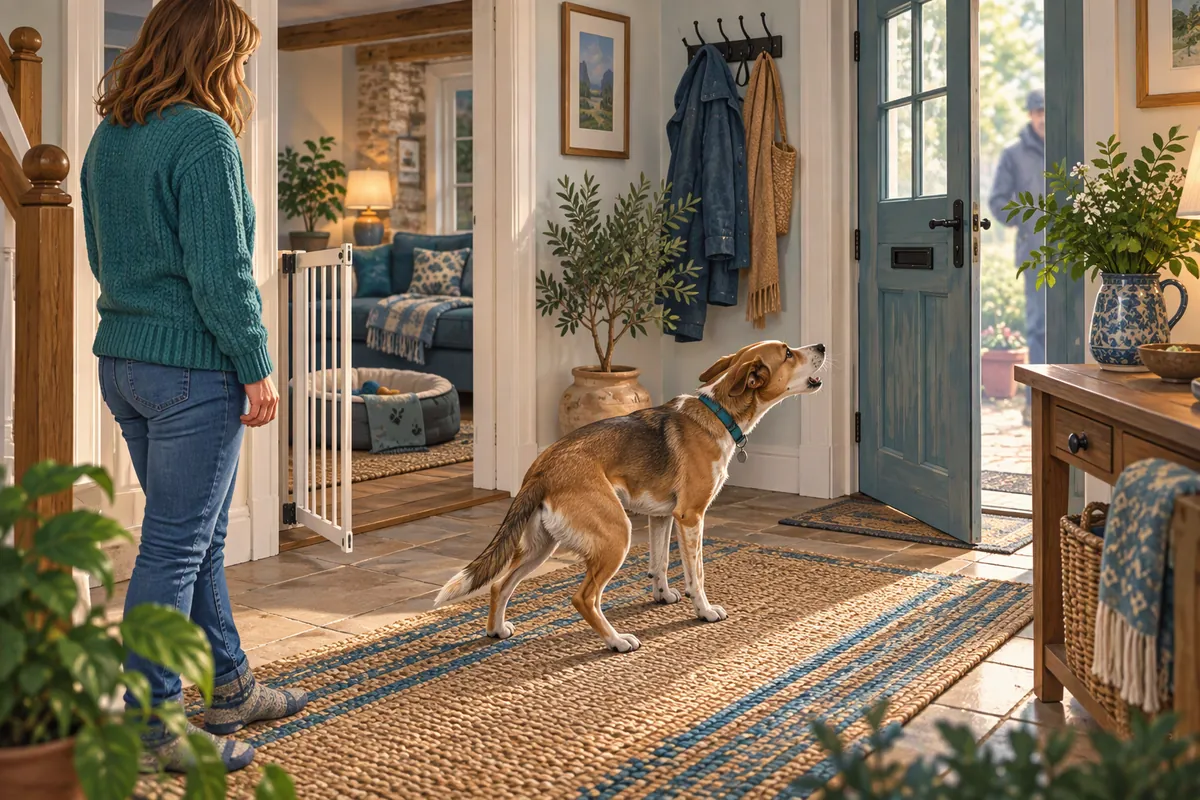
If this sounds like your dog
A knock, the bell, footsteps outside, and he’s at the door: barking, snarling, hackles up. Maybe it’s new, and he never used to do it. Friends say he’s a good guard dog. You’re not so sure, and visits have become something everyone dreads.
Protective, or feeling vulnerable?
“He’s protecting us” is the explanation most people reach for, and it’s understandable: he puts himself between you and the door. But a dog who is confidently guarding is usually calm and deliberate. A dog who feels vulnerable tends to be loud, frantic and on the move.
| Often feeling vulnerable | More like confident guarding |
|---|---|
| Rushes forward, then backs off or circles | Stands still and steady, watching |
| Keeps barking after the visitor is inside | Settles once the visitor is in and things are calm |
| Weight back, ears back, tail low | Body forward but loose, no frantic movement |
| Keeps away from the visitor, or watches them all visit | Can be friendly once introduced |
| Worse when he’s tired, unwell or already stressed | Much the same whatever his day has been like |
Most dogs are a mix, and it can change from day to day. You don’t need to get it exactly right. What helps is much the same either way, and working out what’s driving it is where help makes the biggest difference.
Why the door is such a big moment
- Someone he doesn’t know arrives without warning, in the place where he should feel safest.
- Hallways are narrow, and there’s often nowhere for him to go.
- Visitors tend to look at him, lean over him, talk to him or reach for him, which is everything a worried dog finds hardest.
- When the visitor leaves, or the delivery driver walks away, the barking seems to him to have worked. That’s one reason it often grows over time.
When it starts out of the blue
If a dog who never used to do this has started, ask what else has changed. Pain and illness make dogs far less able to cope, and pain can be hard to spot. In one study, dogs referred for aggression often turned out to have musculoskeletal pain nobody had noticed (Barcelos, Mills and Zulch, 2015). If he’s been unwell, the barking may be part of that, not a separate problem to tackle later.
What helps
- Make arrivals quieter and predictable. Ask people to text instead of knocking, and open the door before they reach it.
- Set him up somewhere safe before visitors arrive. Choose a room or a gated area away from the door, with something good to chew. Do it in advance, not in the middle of the barking.
- Don’t grab his collar or pull him back. It takes away his option to move away, and it can turn worry into snapping. A gate already in place, or calling him away cheerfully, works better.
- Brief visitors. No looking, talking or reaching. Let him decide whether, and when, to come and sniff.
- Give him a “thank you, I’ve got it”. When he notices a sound, say your cue and move away together to a spot with treats, away from the door (Lee, 2023c). It can look as if you’re rewarding barking, but you’re rewarding him for moving away and checking in with you.
- Never punish the barking or the snarl. A snarl is a warning. If warnings get him into trouble, he may learn to skip them.
When to call the vet, and when to ask for help
See your vet first if this is new, if it started suddenly, or if he seems sore or unwell.
Ask for help straight away if:
- he has snapped or bitten, or snaps when someone reaches for him
- children visit, or you’re worried someone could be hurt
Ask for help soon if:
- it’s getting worse, or spreading to invited guests or people he knows
- he takes a long time to settle after visitors leave
- you’ve stopped having people round
And any time you’re finding it hard, or don’t know what to try next.
Further reading
- Barcelos, A.-M., Mills, D.S. and Zulch, H. (2015) ‘Clinical indicators of occult musculoskeletal pain in aggressive dogs’, Veterinary Record, 176(18), p. 465. Available at: https://doi.org/10.1136/vr.102823
- Lee, E.-J. (2022a) Understanding your reactive dog [E-book]. Lighten Up Dog Training.
- Lee, E.-J. (2023c) Alert & alarm barking: reducing barking without pain [Protocol]. Lighten Up Dog Training.
- Mills, D.S. et al. (2020) ‘Pain and problem behavior in cats and dogs’, Animals, 10(2), 318. Available at: https://doi.org/10.3390/ani10020318