
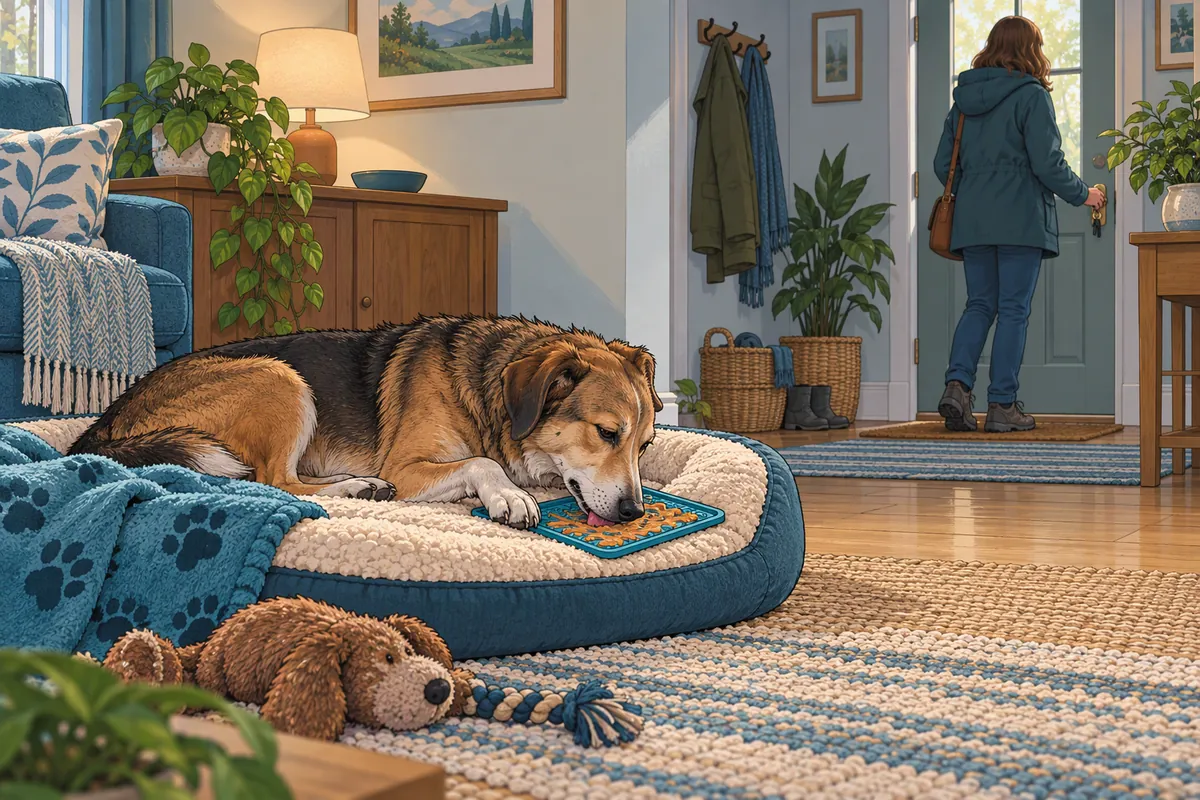
You pick up your keys and he’s already at the door. You come home to scratched paintwork, a puddle, or a neighbour telling you he howled the whole time you were out. Or he’s fine for an hour, but not for three.
What it can look like
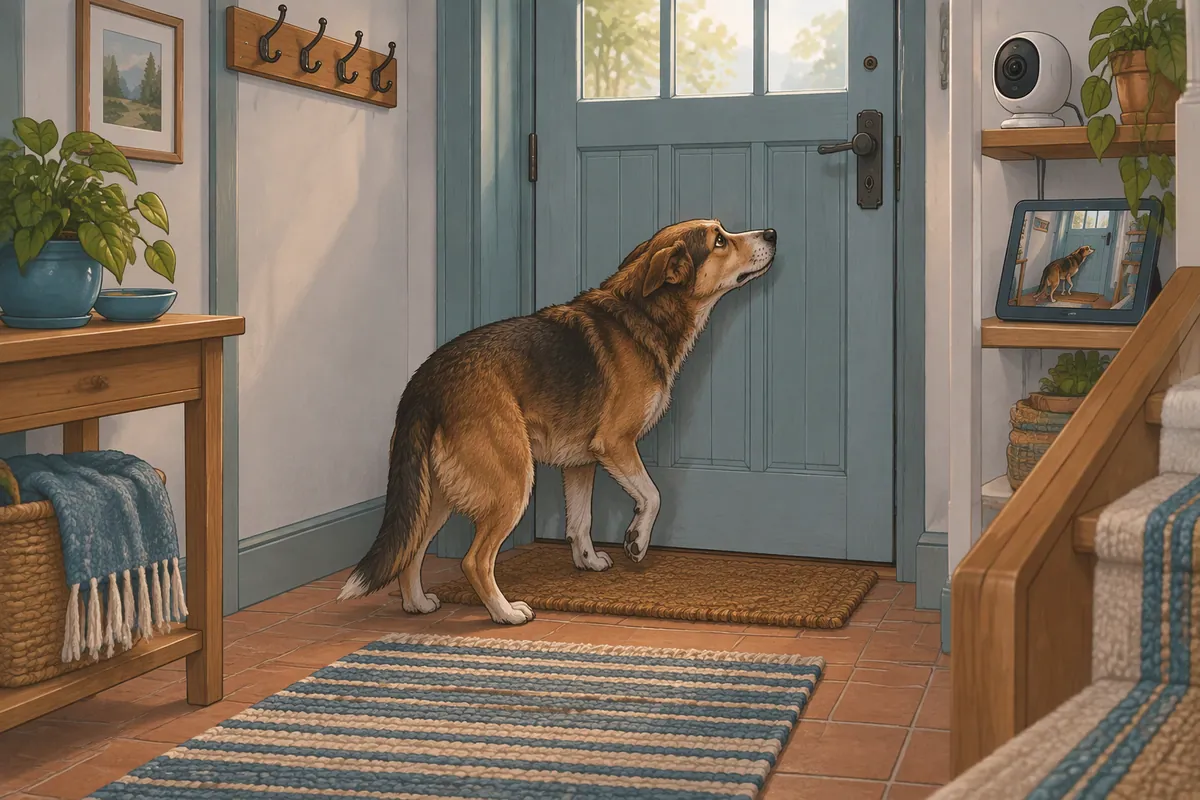
While you’re out, or as you get ready to go:
- barking, howling or whining
- scratching or chewing at doors and windows, or trying to escape
- weeing or pooing indoors when he’s clean the rest of the time
- pacing, panting, drooling, or not touching food you left for him
- following you from room to room, or getting worried when you pick up your coat
A dog who loves being with you isn’t “too attached”. Dogs are a social species, and most adult dogs show all the signs of a real bond with their people, including some upset when separated (Payne, Bennett and McGreevy, 2015). The problem isn’t the bond. It’s how hard being alone has become for him.
Is it separation anxiety? Not every dog who struggles is panicking
“Separation anxiety” is the name most people know, but research suggests separation problems aren’t one thing (de Assis et al., 2020). Two pictures are common. They look similar from the outside, but need different help.
- “I need you here.” He’s upset because you have gone. He may follow you closely, worry as you get ready, and settle quickly when someone else stays with him.
- “Let me out!” He’s frustrated by the door or the barrier, not by being apart from you. He may be fine loose in the house but frantic behind a closed door or in a crate, focus his efforts on the exit, or calm down once he can get to the garden.
Many dogs are a mix, and noise worries can play a part too: a dog who is frightened by a sound while alone has no one to turn to. Working out which picture fits your dog is the first thing I’d do with you, because it changes the plan. A dog who is frustrated by the door may need a different set-up more than practice at being alone.
Start with your vet
Before any training, book a check-up. Toileting indoors can have a medical cause, and pain or discomfort makes any dog less able to cope with stress, including being alone. Tell your vet what’s happening at home, and take a short video if you can.
Your vet is also the person to talk to about medication. For some dogs, being alone is so frightening that they can’t learn while they’re in that state. Medication can lower the panic enough for the training to work. In France there are medicines licensed specifically for separation-related problems, used alongside a behaviour plan rather than instead of one. Only a vet can prescribe them. There’s more in Medication for anxiety.
Try not to leave him longer than he can cope with
Every time he panics alone, being alone gets a little scarier. So while you work on it, the most helpful thing you can do is stop those absences happening, as far as your life allows. This is the hardest part for most families, so be kind to yourself about it.
- Find out how long he can manage. Film him next time you go out (a phone or a cheap pet camera is fine). Many guardians are surprised how quickly the upset starts, or how long he actually copes.
- Fill the gaps. A friend or neighbour, a dog sitter, a day at a trusted home, or a dog-friendly workplace or café. Short-term arrangements are fine; this isn’t forever.
- Change the set-up if the door is the problem. If he’s frantic behind a closed door or in a crate, try a baby gate, the run of more rooms, or (where safe) access to the garden.
- Make his resting place a good one. Somewhere comfortable, away from the front door and street noise, perhaps with some background sound to mask what’s going on outside.
Helping being alone feel ordinary
The aim isn’t to trick him into not noticing you’ve gone. It’s to make your going, and your coming back, feel like no big deal. It’s the same gentle, step-by-step approach as in Changing how scary things feel.
- Teach him to rest while you’re home. A comfy mat or bed where good, calm things happen: a chew, a gentle stroke, quiet praise. Practise while you potter about, so being settled a few metres from you becomes easy.
- Make comings and goings boring. Keep hellos and goodbyes low-key. Pick up your keys or put on your coat at random times during the day without going anywhere.
- Give him a “you’re safe” signal. Something that reliably means calm, quiet time, like a particular mat, a radio programme or a lamp. Use it during your relaxed time at home first, so it has a good meaning before you rely on it.
- Build up absences very gradually. Start with an absence so short he doesn’t react: stepping outside the door for a few seconds. Watch him on camera. If he stays relaxed, the next one can be a little longer; if he shows any worry, go back to an easier step. Mix short and longer absences rather than always going up (Butler, Sargisson and Elliffe, 2011).
- Chews and food puzzles are fine. A dog who is chewing, sniffing or sleeping is a dog who is coping. They won’t fix a real panic, but they can help a dog settle.
Progress is rarely a straight line. A bad day doesn’t undo the work; just go back a step.
What usually makes it worse
- Telling him off when you get home. He can’t link it to what happened hours ago, and it makes your return something else to worry about.
- “Letting him get used to it” by leaving him for long periods and hoping he settles. For a dog who is panicking, this usually makes things worse, not better.
- Bark collars, sprays or other devices that punish the noise. They add fear to a dog who is already frightened, and they don’t touch the reason he’s barking.
- Pushing him away to make him “more independent”. Taking away comfort doesn’t build confidence. Feeling safe with you is what helps him cope without you.
When to ask for help
Ask for help if he’s hurting himself trying to escape, if neighbours are complaining, if you can’t avoid leaving him for longer than he can manage, or if things aren’t improving after a few weeks of small steps. Separation problems respond well to a plan built around your own dog and your own routine.
Further reading
- Butler, R., Sargisson, R.J. and Elliffe, D. (2011) ‘The efficacy of systematic desensitization for treating the separation-related problem behaviour of domestic dogs’, Applied Animal Behaviour Science, 129(2–4), pp. 136–145. Available at: https://doi.org/10.1016/j.applanim.2010.11.001
- de Assis, L.S. et al. (2020) ‘Developing diagnostic frameworks in veterinary behavioral medicine: disambiguating separation related problems in dogs’, Frontiers in Veterinary Science, 6, 499. Available at: https://doi.org/10.3389/fvets.2019.00499
- Lee, E.-J. (2023) Understanding frustration in dogs [Online course]. Lighten Up Dog Training. Available at: https://lighten-up-dog-training.teachable.com/p/understanding-frustration-in-dogs
- Lee, E.-J. (2025) Moving beyond fear and anxiety 2025–6 [Online course]. Lighten Up Dog Training.
- Payne, E., Bennett, P.C. and McGreevy, P.D. (2015) ‘Current perspectives on attachment and bonding in the dog–human dyad’, Psychology Research and Behavior Management, 8, pp. 71–79. Available at: https://doi.org/10.2147/PRBM.S74972