
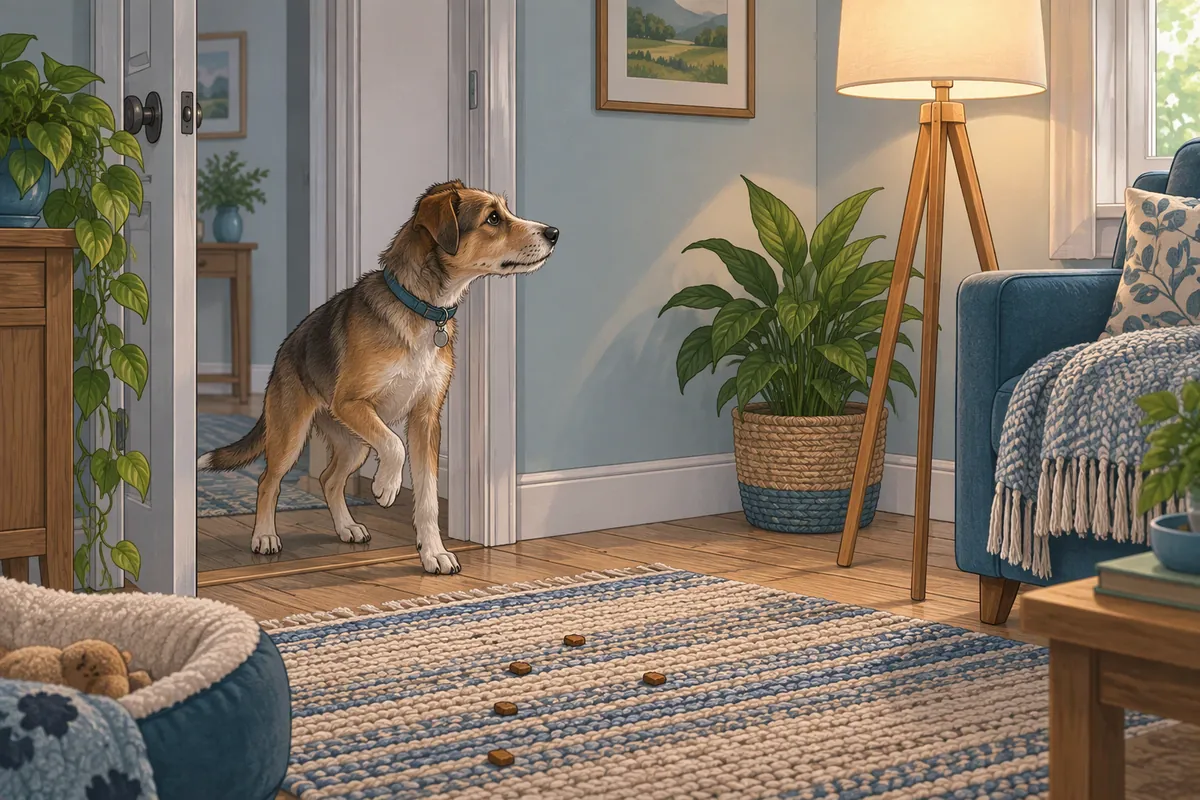
The wheelie bin that’s been at the end of the lane for months. A bag caught on a fence. A statue in the park. Suddenly she’s stopping dead, barking, backing away or refusing to walk past, and you can’t think what’s changed.
You may hear this called a “second fear period”. It’s a common idea among trainers, though the research hasn’t pinned down a distinct, predictable stage. What we do know is that teenage dogs are going through big changes, can be more sensitive to unpleasant experiences, and learn quickly from them.
Let her look
- Stop, and give her time. Stand still with a loose lead and let her look, sniff the air and work it out. Many dogs settle on their own if they aren’t rushed.
- Let her choose. If she wants to go closer, let her, slowly, at her own pace. If she wants to leave, go with her. Being allowed to move away often makes a dog braver next time.
- Don’t drag or lure her closer. Pulling her towards it, or using treats to tempt her nearer than she wants to go, can leave her stuck close to something scary. That usually makes the fear stronger, not weaker.
- Keep calm and chatty. A relaxed voice and a few treats scattered on the ground (away from the scary thing) help her body relax.
Build her confidence elsewhere
- Keep life predictable. Familiar routes and routines give her a safe base. Add new places gradually, and go back to easy walks after a wobble.
- Sniffing, play and simple games. Regular sniffing has been linked with a more optimistic outlook in dogs (Duranton and Horowitz, 2019), and games she knows well (like a counting game, “one, two, three” with a treat on three) give her something familiar to hold on to in new places.
- Avoid overwhelming outings. Busy markets, beaches or fairs “to get her used to it” can backfire with teenagers. Short, easy, successful trips are better.
Check her health
Sudden new worries can come from pain, or from changes in sight or hearing. A vet check rules these out.
When to ask for help
Get help if the fears are spreading to more things, if she takes much longer to settle than she used to, if she won’t eat or toilet on walks, or if she’s becoming reluctant to go out at all. Helping a teenage dog early makes a real difference.
Further reading
- Duranton, C. and Horowitz, A. (2019) ‘Let me sniff! Nosework induces positive judgment bias in pet dogs’, Applied Animal Behaviour Science, 211, pp. 61–66. Available at: https://doi.org/10.1016/j.applanim.2018.12.009
- Lee, E.-J. (no date) Success with impulsive dogs [Online course]. Lighten Up Dog Training.
- Lee, E.-J. (2025a) Moving beyond fear and anxiety 2025–6 [Online course]. Lighten Up Dog Training.