
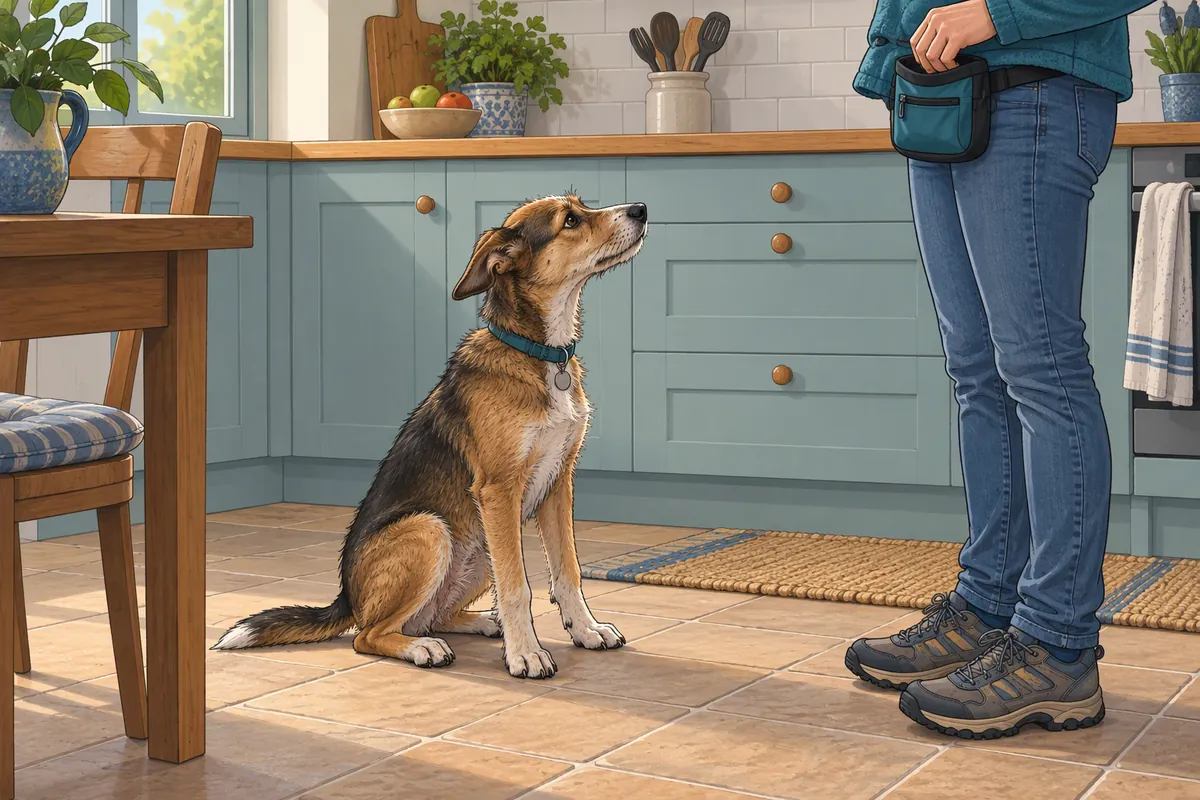
He aced puppy class. He sat, waited and came back every time. Now he looks straight through you when you call, pulls like a train, jumps on visitors and seems to have forgotten his own name. It can feel personal.
Research has found that teenage dogs can become less responsive to their own carer for a while, much like human teenagers (Asher et al., 2020). At the same time, everything out there (smells, other dogs, wildlife, people) has become far more exciting, and staying in control is harder for him.
Go back to easy
- Practise where it’s easy to get right: at home, in the garden, on quiet walks. Then build up slowly to busier places, the way you did when he was small.
- Make it worth his while. Use better rewards than you think you need, and vary them: food, toys, a game, a sniff, the chance to go and say hello. Real-life rewards are powerful.
- Keep sessions short and frequent. A few seconds here and there through the day builds strong habits better than one long session.
Stop him practising the things you don’t want
- Use a long line in open spaces until his recall is reliable again. Every time he runs off and has a great time, he learns that ignoring you pays.
- Manage the hotspots. A gate at the front door, a lead when visitors arrive, food bowls out of reach. Prevention isn’t failure; it buys time while he grows up.
- Reward the good moments. Catch him checking in with you, walking nicely, or choosing to stay. Say “Good!” and reward. Do this lots of times a day.
Avoid harsh corrections
Teenage dogs are especially sensitive to unpleasant experiences. Shouting, lead jerks or “tough love” can damage his trust in you just when your relationship matters most, and often make the behaviour worse. A calm, consistent, kind approach works better and lasts longer.
Look after the basics
Make sure he gets plenty of sniffing, chewing, play and rest. A teenager who is overtired, bored or over-stimulated finds self-control much harder. Many dogs struggle more in the evening or after a busy day, so plan for easier times then.
Check his health
If he’s suddenly reluctant to sit, lie down, jump or walk, pain could be the reason, especially in big, fast-growing dogs. Ask your vet.
When to ask for help
Get help if he’s becoming hard to handle safely, if there’s any growling, snapping or mouthing that hurts, or if you’re feeling at the end of your tether. A plan made for your dog takes the guesswork out of these months.
Further reading
- Asher, L., England, G.C.W., Sommerville, R. and Harvey, N.D. (2020) ‘Teenage dogs? Evidence for adolescent-phase conflict behaviour and an association between attachment to humans and pubertal timing in the domestic dog’, Biology Letters, 16(5), 20200097. Available at: https://doi.org/10.1098/rsbl.2020.0097
- Lee, E.-J. (no date) Success with impulsive dogs [Online course]. Lighten Up Dog Training.
- Sdao, K. (2012) Plenty in life is free: reflections on dogs, training and finding grace. Wenatchee, WA: Dogwise Publishing.