
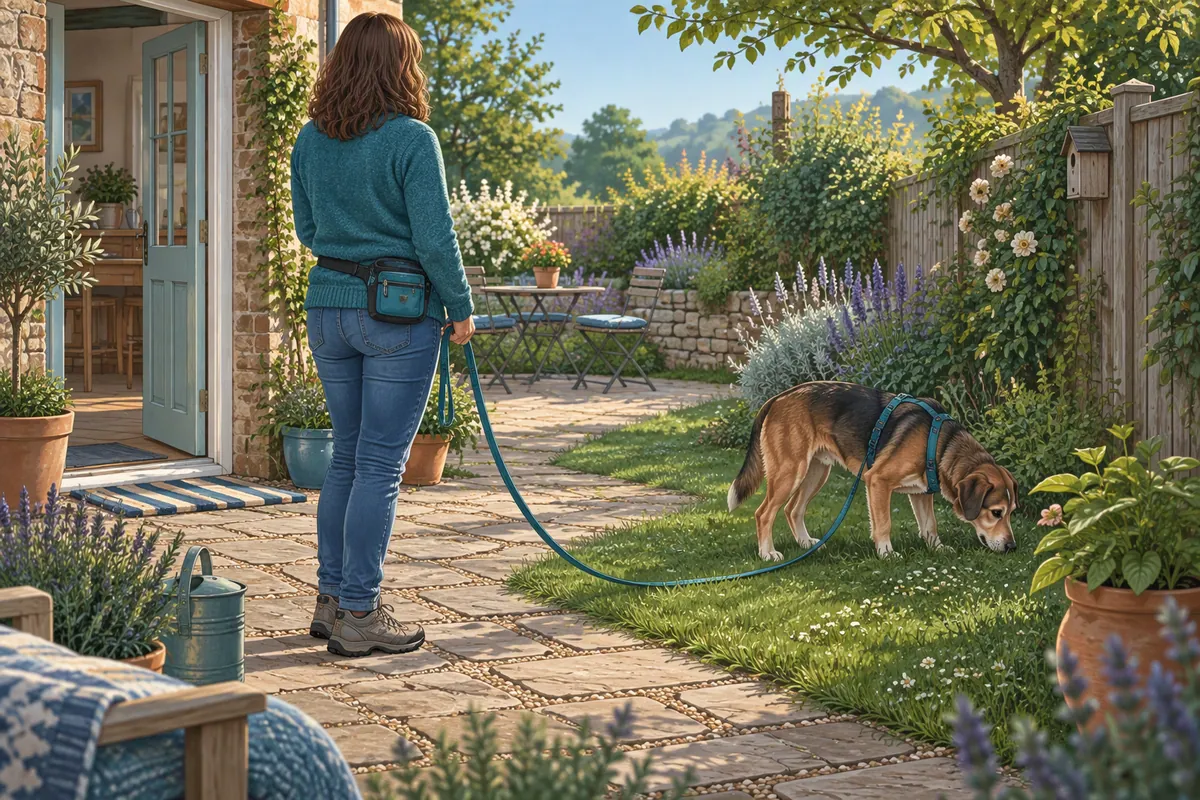
He’s been home a few weeks. You take him out, he sniffs about, comes back in, and wees on the rug. Or you come down in the morning to a mess by the door. You were told he was house-trained, or you hoped he’d pick it up quickly, and it’s wearing you down.
Going to the toilet is normal. With patience, most dogs get there.
Start with your vet
Before anything else, book a check-up. Urine infections, bladder problems, upset stomachs, and conditions that make a dog drink more can all cause accidents, and none of them will improve with training (Houpt, 2009). Tell your vet:
- whether it’s wee, poo or both, and roughly how much
- when it happens: when you’re home, when you’re out, or overnight
- whether he’s drinking more than you’d expect
- whether his bed is ever damp after he’s been lying down
Why it happens in rescue dogs
- He’s never been toilet-trained. Many rescue dogs have lived in kennels, on the street or on a farm. A dog who has always gone on concrete, straw or wherever he happened to be has no idea that indoors is different. A dog who was clean in his last home may need reminding in a new one, too.
- Outside feels frightening. A worried dog may not dare go in an unfamiliar garden, with new smells, sounds and neighbours’ dogs. He holds on during the trip out, then goes the moment he’s back somewhere that feels safe, which is often indoors.
- Marking a new place. Small amounts of wee on furniture, door frames or curtains, often in the first weeks or after a visitor or new dog, are usually marking, not a full bladder.
- Excitement or worry at greetings. Dribbling when someone comes home, leans over him or reaches for his head, often while crouching or rolling over, is an appeasing or excited response. It isn’t a toileting accident.
- Stress, or being left alone. Big changes can upset any dog’s tummy and toilet habits. If he’s clean when you’re home but goes soon after you leave, being alone may be the problem. See He can’t be left alone.
What helps
- A predictable routine. Take him out first thing, last thing, and after sleeping, eating, drinking and play. For an adult dog, start at about every two hours, then stretch the gaps gradually as he gets it right (Houpt, 2009). Regular mealtimes make toilet times easier to predict.
- Go out with him, and reward him outside. Stay with him, on a long lead if needed, and be quiet and boring while he sniffs. The moment he finishes, praise him and give him a really good treat, right there, not when you’re back indoors. If going to the toilet always ends the outing, some dogs learn to hold on, so have a sniff or a wander after he’s been.
- Make outside feel safe. Choose a quiet corner of the garden, out of view of the road. Go at quiet times. Stand still and look away rather than watching him closely; many dogs feel vulnerable while they squat. If he came from a kennel, a patch of the surface he’s used to (concrete slabs, straw) can help him make the switch.
- Clean up with an enzyme cleaner. Biological pet-accident cleaners break down the smell; ordinary cleaners leave enough behind to draw him back to the same spot. Soak carpets rather than just spraying them.
- Manage the house while he learns. Keep him where you can see him, using baby gates or a light lead indoors, so you can spot the signs (sniffing the floor, circling, heading for a corner) and take him straight out. When you can’t watch, use a small, comfortable area where he’s happy to rest. Close doors to favourite accident spots. Wait until he’s had four to eight weeks with no accidents before giving him the run of the house unsupervised (Hunthausen, 2009).
What to avoid
- Punishment, of any kind. He can’t link a telling-off to a puddle made earlier, and even catching him in the act teaches him to be afraid of going in front of you. He then hides behind the sofa to go, or holds on outside until you’re out of sight. The “guilty look” is him reacting to you, not remembering what he did (Houpt, 2009).
- Rubbing his nose in it. It doesn’t teach him anything, and it frightens him.
- Shutting him out in the garden alone. If you aren’t there, you can’t reward him for getting it right, and a treat when he comes back in teaches him to come in, not to go outside.
When to ask for help
Get help if your vet has found nothing and you’ve been consistent for a couple of weeks without progress, if he only has accidents when he’s alone or when someone approaches him, if he seems frightened to go outside at all, or if it’s straining your relationship with him.
Further reading
- Houpt, K.A. (2009) ‘House soiling by dogs’, in Horwitz, D.F. and Mills, D.S. (eds) BSAVA manual of canine and feline behavioural medicine. 2nd edn. Gloucester: British Small Animal Veterinary Association, pp. 111–116.
- Hunthausen, W. (2009) ‘Preventive behavioural medicine for dogs’, in Horwitz, D.F. and Mills, D.S. (eds) BSAVA manual of canine and feline behavioural medicine. 2nd edn. Gloucester: British Small Animal Veterinary Association, pp. 65–74.
- Lee, E.-J. (2022a) Understanding your reactive dog [E-book]. Lighten Up Dog Training.