
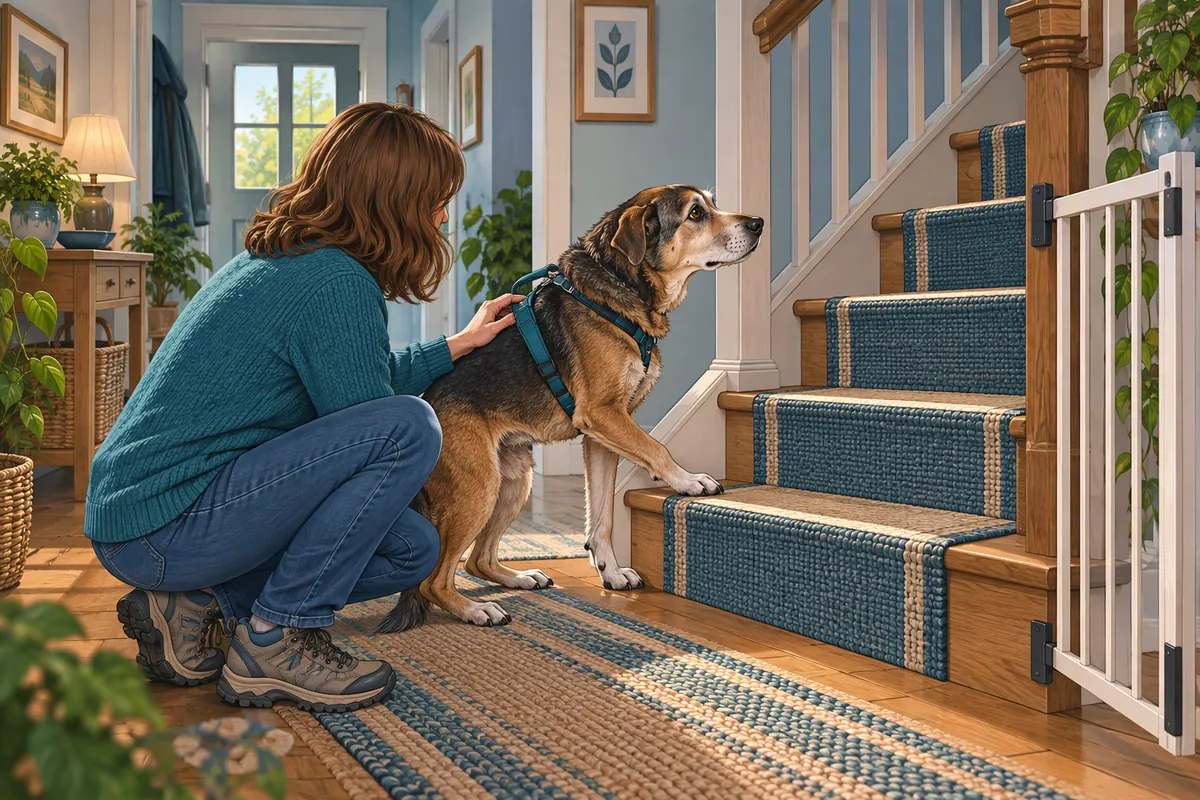
She’s gone up and down those stairs a thousand times. Now she stands at the bottom, whining, or stops halfway, trembling. Maybe she slipped last week. Maybe nothing happened that you saw. Either way, she won’t do it, and you don’t know whether to coax her or carry her.
Dogs who are in pain often avoid certain floors, stairs or rooms (Mills et al., 2020), so this is worth taking seriously.
What can make stairs hard
- Pain or weakness in the hips, knees, back or shoulders.
- Changes in sight. Steps can be hard to judge in poor light, especially plain carpet where every step looks the same.
- Slippery surfaces. Wooden or tiled stairs give tired legs nothing to grip.
- A slip or fall. One frightening moment can be enough for a dog to decide the stairs aren’t safe.
- Coordination. Some older dogs lose a little awareness of where their back feet are.
See your vet first
Film her approaching the stairs, and walking and getting up on a flat floor, and show your vet. If she has fallen, seems weak or wobbly, or the change came on overnight, ring the vet promptly.
Keep her safe now
- Gate the stairs so she can’t try them alone and fall.
- Bring her life downstairs for now: a comfortable bed, water and company on the ground floor. If she sleeps upstairs with you, could someone sleep downstairs with her for a while?
- If she needs carrying, warn her first, support her chest and back end, and keep it calm and quick. Watch for any sign that lifting hurts.
Don’t push, drag or lure
Pulling her up by the lead, pushing from behind or tempting her with food to go further than she wants can end in a fall, and it makes the stairs scarier. Let her decide.
Make the stairs easier
- Grip: non-slip stair treads or a runner on wooden or tiled stairs.
- Light: good lighting on the stairs, and perhaps a contrasting strip on each step edge so she can see where it ends.
- Support: a well-fitted harness with a handle lets you steady her without lifting.
- A ramp for a few steps, such as at the back door or into the car.
Rebuild confidence slowly, if it’s safe to
Once your vet is happy, and only if she’s physically able, let her explore the bottom step in her own time. Reward her calmly for any step she chooses to take, then let her come straight back down. Short, easy sessions, finishing before she’s had enough. Some dogs will never be comfortable on stairs again, and living downstairs is a perfectly good answer.
When to ask for help
Get help if her worry is spreading to other floors, doorways or the car, or if she’s becoming reluctant to move around the house.
Further reading
- Landsberg, G.M. and Denenberg, S. (2009) ‘Behaviour problems in the senior pet’, in Horwitz, D.F. and Mills, D.S. (eds) BSAVA manual of canine and feline behavioural medicine. 2nd edn. Gloucester: British Small Animal Veterinary Association, pp. 127–135.
- Lee, E.-J. (2025a) Moving beyond fear and anxiety 2025–6 [Online course]. Lighten Up Dog Training.
- Mills, D.S. et al. (2020) ‘Pain and problem behavior in cats and dogs’, Animals, 10(2), 318. Available at: https://doi.org/10.3390/ani10020318