
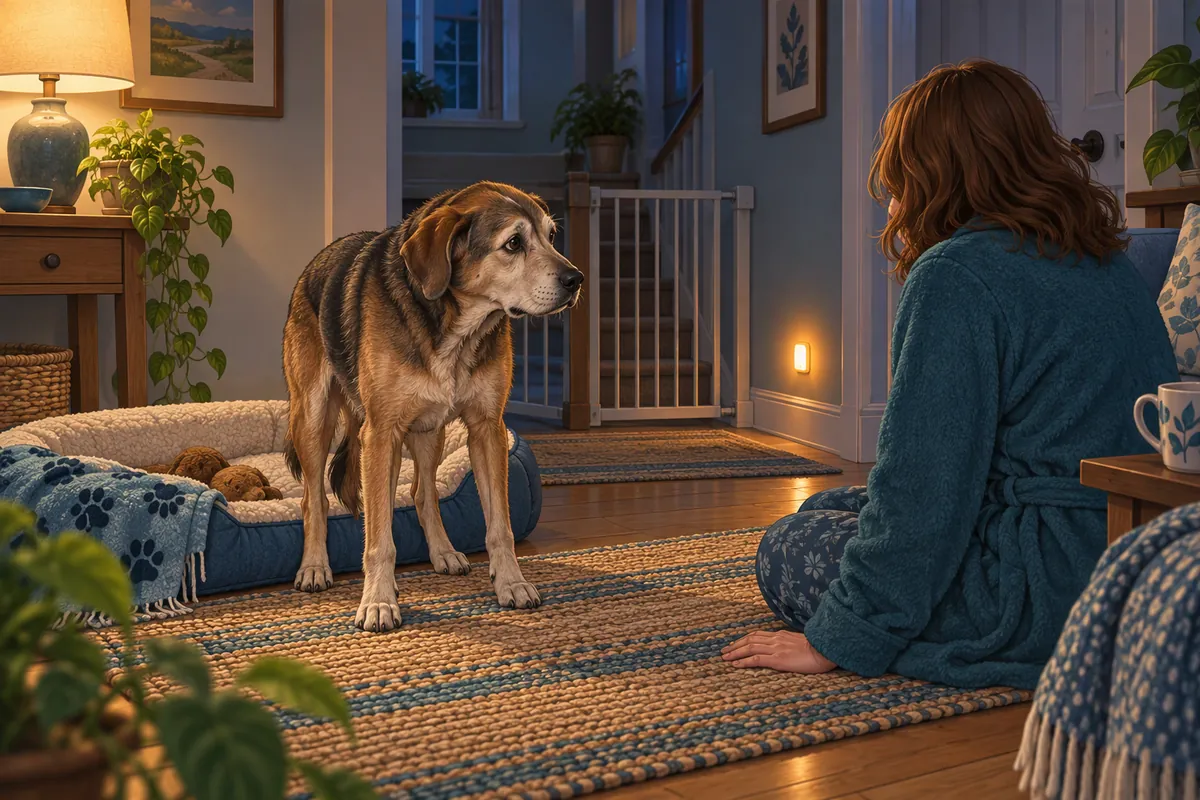
He’s up at 3 am, pacing, panting or barking at nothing. He stands staring at a wall, waits at the wrong side of the door, or seems lost in a room he’s known for years. In the day he sleeps far more than he used to. You’re exhausted, and worried about what it means.
Sometimes it’s physical: discomfort, needing to wee more often, or not seeing or hearing well in the dark. Sometimes it’s changes in the brain, a bit like dementia in people, which vets call cognitive dysfunction. Often it’s a mix (Landsberg and Denenberg, 2009).
See your vet first, and tell them everything
Many owners assume changes like these are “just old age” and don’t mention them. Please do. Write down what you’ve noticed and when it started, even small things:
- waking or pacing at night, and sleeping more in the day
- seeming lost, staring, or getting stuck behind furniture or at the wrong side of doors
- less interest in greeting you, or suddenly much clingier
- accidents indoors after years of being clean
- forgetting things he knew, or being slower to respond to his name
- drinking more, or needing to go out more often
Your vet will look for pain, sight and hearing loss, and conditions that make dogs wee more or feel unwell, before deciding whether brain changes are part of the picture. They can also talk to you about treatments, including medication or diet, that may help.
A good day makes a better night
- Keep his days interesting. A dog who sleeps all day is more likely to be awake at night. Gentle sniffy walks, a food puzzle, a short training game or a scatter feed in the garden all help.
- Keep a steady routine. Meals, walks and bedtime at the same times each day help him know where he is in the day.
- Last trip out late. A final toilet trip just before bed, and an easy way to ask to go out in the night.
Make the night feel safe
- A night light and a comfortable, supportive bed somewhere quiet.
- Somewhere safe to wander. A gate across the stairs and a small, familiar area at night means he can’t get stuck or fall.
- Keep things where they are. Moving furniture or his bed can confuse a dog who is relying on memory. Make any changes gradually.
- Help him find his way. A rug by the door or a familiar smell on his bed gives him extra clues when his eyes or memory aren’t as good.
- Sleep nearer him for a while if it settles him.
When he’s unsettled
Stay calm. Telling him off adds worry; it can’t fix confusion. A quiet word, a trip outside if he needs it, then settling him back on his bed is enough. If he’s waking to something specific, such as a neighbour’s dog or a noise, see whether you can block or mask it.
When to ask for help
Talk to your vet promptly if he’s unsettled most nights, seems distressed, or the change came on suddenly. Behaviour support can help with routines, enrichment and changes to the home, alongside your vet’s treatment.
Further reading
- Landsberg, G.M. and Denenberg, S. (2009) ‘Behaviour problems in the senior pet’, in Horwitz, D.F. and Mills, D.S. (eds) BSAVA manual of canine and feline behavioural medicine. 2nd edn. Gloucester: British Small Animal Veterinary Association, pp. 127–135.