
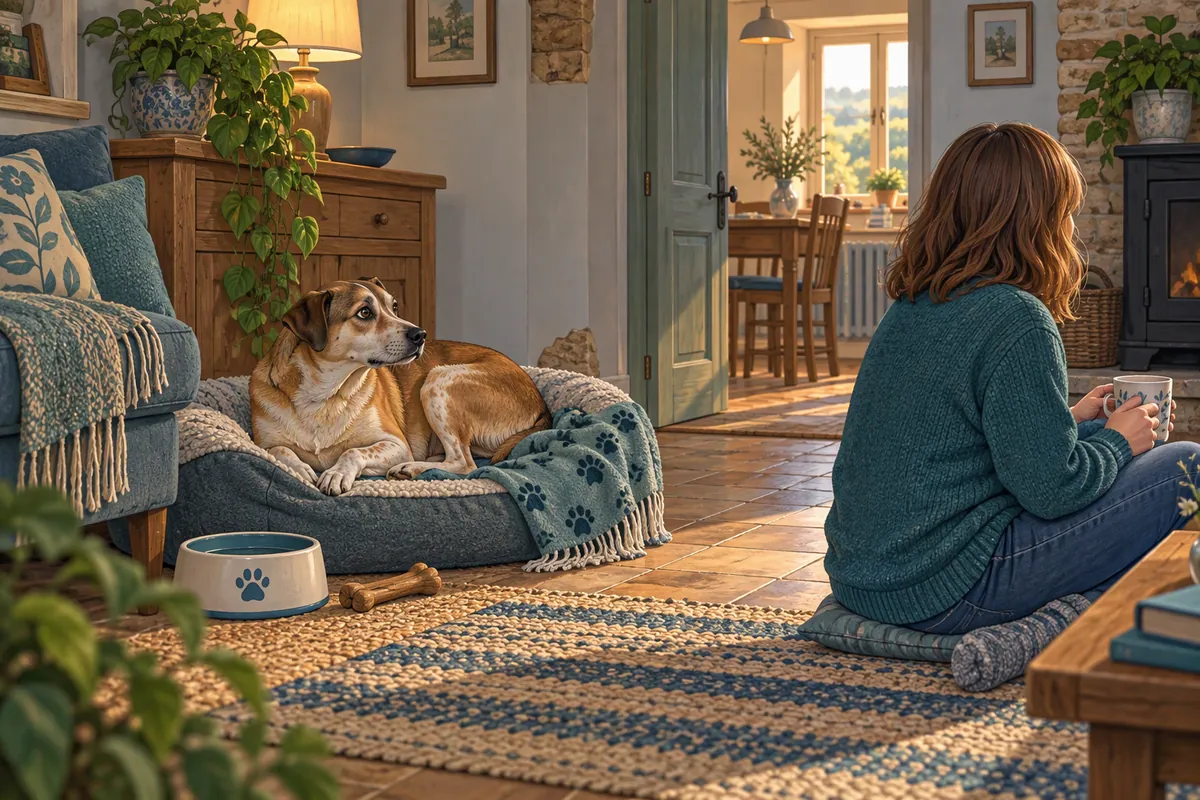
If this sounds like your dog
You’ve given them a warm bed, good food and a quiet home. Nobody shouts and nobody hurts them. And yet they jump when you stand up, watch the door, won’t eat while you’re in the room, or pace when the house goes quiet at night.
It’s easy to wonder what you’re doing wrong. Usually the answer is nothing. Your dog just hasn’t caught up with their new life yet.
Why being safe and feeling safe aren’t the same
Moving through a shelter, a journey and a new home is a lot of change in a short time. A dog who seems jumpy, can’t settle or won’t eat at first may still be running on stress hormones.
Your dog also has no way of knowing that this home is different. Everything is new: the sounds, the smells, the people, the routine. Whatever happened before taught them what to expect from the world, and it can take a long time for new experiences to outweigh old ones.
Dogs learn that they’re safe the same way we do: the same good things happening in the same way, day after day, with nothing bad happening in between. You can’t explain it to them. They have to live it, many times over.
What “not feeling safe yet” can look like
- watching doors and windows, or startling at small sounds
- hiding, or staying in one spot for most of the day
- eating only when nobody is around
- following you everywhere, or never coming close
- pacing or not sleeping well at night
- accidents indoors, even in a dog who is house-trained
- being very quiet and still, which can look like being “good”
That last one is easy to miss. A dog who does nothing at all isn’t always relaxed. Sometimes they’re simply too worried to do anything.
What helps them feel safe
- Make the days predictable. Meals, walks, quiet time and bedtime at roughly the same times, in the same order. Predictability is how a dog starts to trust what comes next.
- Give them a safe place. A bed or covered crate in a quiet corner, where nobody follows them and nobody disturbs them.
- Let them choose. Let them come to you, rather than going to them. Sit down, look away, and let them decide how close to be.
- Keep the world small for a while. Fewer visitors, short and quiet walks, no big outings. There’s plenty of time for more later.
- Food with no strings. Put food down and step away. Don’t use it to coax them closer, which can leave them torn between wanting the food and wanting distance.
- Let them rest. Dogs need far more sleep than people, and a worried dog needs even more to recover.
How long does it take?
There’s no set timetable. Some dogs relax within weeks; for others it takes months, and progress is rarely a straight line. A good week followed by a wobbly one is normal, especially after a change such as a visitor or a trip to the vet.
Look for small signs rather than big ones: lying down a little more, sleeping more deeply, eating with you nearby, or choosing to be in the same room. Those are your dog starting to feel it.
When to call the vet, and when to ask for help
See your vet first if your dog isn’t eating or drinking, seems unwell, or something changes suddenly. Pain and illness can look a lot like fear.
Ask for help straight away if they growl, snap or bite, or you’re worried someone could be hurt.
Ask for help soon if:
- after several weeks, their fear isn’t easing or is getting worse
- fear stops them eating, sleeping or toileting normally
And any time you’re finding it hard, or don’t know what to try next. You don’t need to wait until things are bad.