
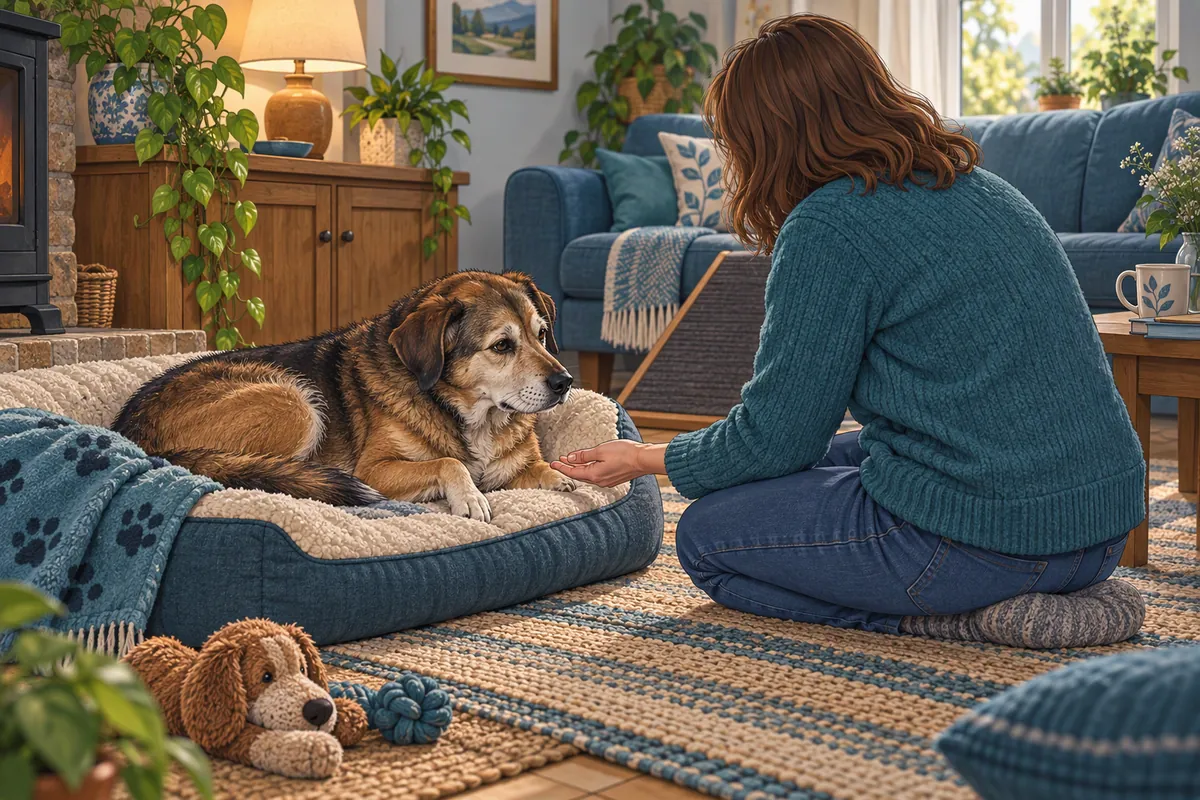
For years she loved a fuss. Now she grumbles when you stroke her back, snaps when you lift her into the car, or growls if she’s woken. It’s upsetting, and it can feel as if she’s turned against you.
Pain is a frequent, often hidden, reason for behaviour changes (Mills et al., 2020), and a first snap during handling often comes in old age. She’s telling you something has changed for her.
Why touch has become hard
- Pain. Sore joints, back, teeth, ears or skin make touch, lifting and being moved uncomfortable, or worry her that they might be.
- Being startled. If her sight or hearing is fading, a hand that appears from nowhere, or being touched while asleep, can make her jump and snap before she’s fully awake.
- A body that won’t do what it used to. Being pushed off the sofa or helped up can be frustrating when getting up is already hard.
See your vet first
Tell your vet exactly where and when she snaps, for example “when I touch her lower back” or “when I lift her”. Short videos of her getting up, walking and lying down help. Your vet may suggest a trial of pain relief while you note whether the snapping changes. Even once pain is treated, she may still expect touch to hurt for a while, so gentle rebuilding helps.
Make touch predictable and her choice
- Warn her first. Say her name and let her see you coming. Wake her with your voice, never your hand.
- Let her come to you. Offer your hand at her side and wait. If she leans in, stroke gently for a moment, then stop and see if she asks for more. If she moves away, let her go.
- Stick to the places she likes. Many dogs prefer the chest or side of the neck. Leave sore areas, paws and the back end alone for now.
- Leave her be when she’s resting or eating. Give her a comfortable bed away from busy doorways, where no one disturbs her.
- Lift less. Ramps, steps and non-slip mats mean she can get in and out of the car and on and off the sofa herself.
Grooming, care and the vet
Necessary care, such as brushing, nails, ear drops and examinations, can be broken into tiny steps, with a way for her to say “I’m ready” (resting her chin on a towel, for example) and “stop”. Keep sessions very short. If you need to handle her before she’s comfortable, a well-fitted basket muzzle, introduced slowly with treats, keeps everyone safe.
Don’t punish the growl
A growl or snap is a warning. Telling her off doesn’t remove the pain or worry; it just teaches her to skip the warning next time (Shepherd, 2009). Instead, stop what you were doing and note it down.
Keep everyone safe
Give children and visitors clear rules: let her come to them, no hugging or reaching over her, and leave her alone when she’s resting.
When to ask for help
Get help if she has bitten, if the snapping is getting more frequent or spreading to new situations, or if she needs regular care you can’t give safely.
Further reading
- Landsberg, G.M. and Denenberg, S. (2009) ‘Behaviour problems in the senior pet’, in Horwitz, D.F. and Mills, D.S. (eds) BSAVA manual of canine and feline behavioural medicine. 2nd edn. Gloucester: British Small Animal Veterinary Association, pp. 127–135.
- Lee, E.-J. (2023a) Understanding frustration in dogs [Online course]. Lighten Up Dog Training.
- Mills, D.S. et al. (2020) ‘Pain and problem behavior in cats and dogs’, Animals, 10(2), 318. Available at: https://doi.org/10.3390/ani10020318
- Shepherd, K. (2009) ‘Behavioural medicine as an integral part of veterinary practice’, in Horwitz, D.F. and Mills, D.S. (eds) BSAVA manual of canine and feline behavioural medicine. 2nd edn. Gloucester: British Small Animal Veterinary Association, pp. 10–23.